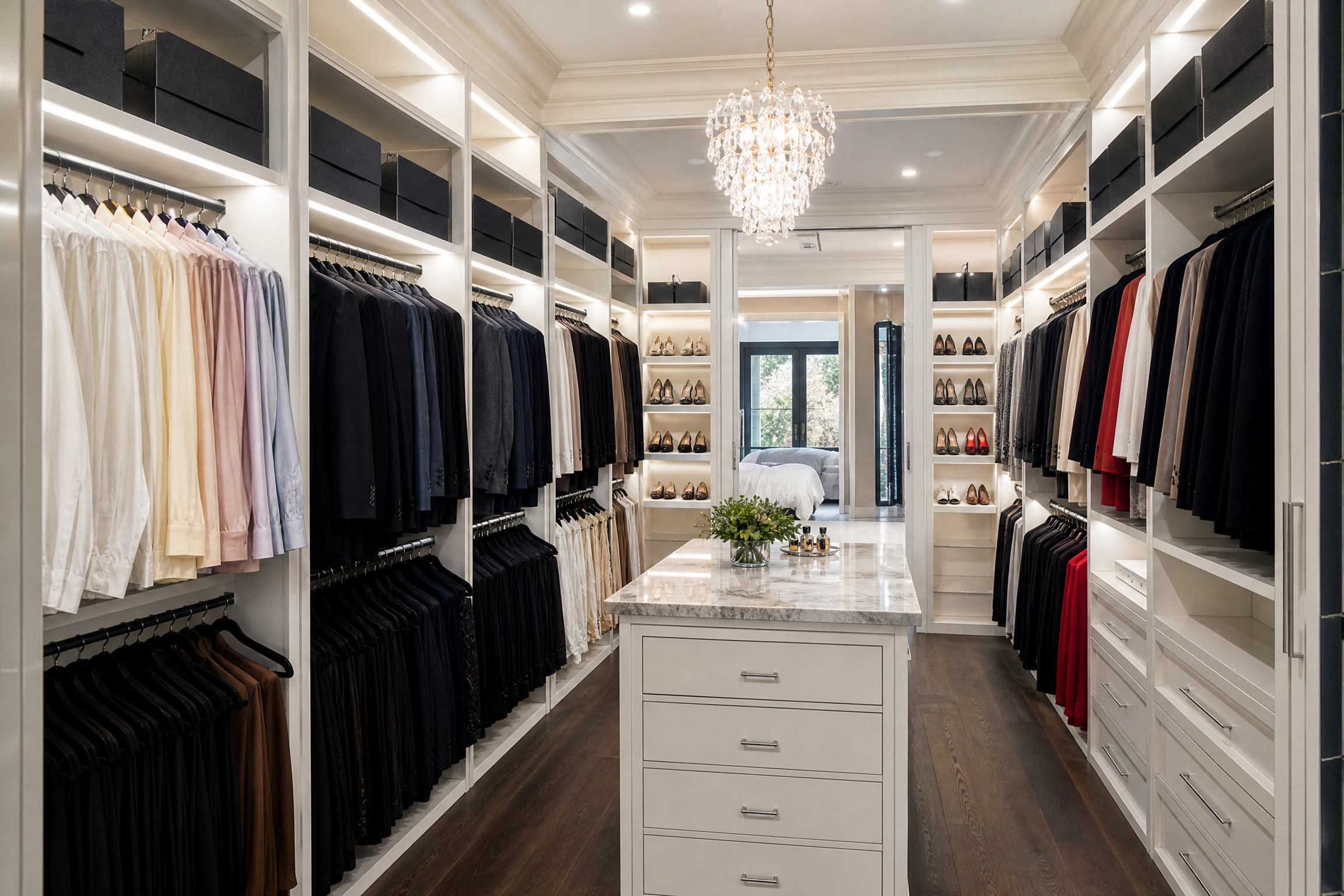
The Professional Organizer’s Four-Phase Blueprint: 25 Bedroom Closet Organization Ideas
A chaotic, overstuffed bedroom closet is not just a minor architectural inconvenience; it is a massive psychological burden that actively sabotages the very beginning of your day. Waking up and staring into a dark, messy cavern filled with wrinkled clothes, mismatched plastic hangers, and towering piles of unworn shoes instantly spikes your cortisol levels and induces severe decision fatigue before you even step out of the bedroom. The traditional approach of simply buying more plastic storage bins and haphazardly shoving them into the remaining gaps is completely fundamentally flawed. You cannot organize clutter; you can only hide it temporarily until the system inevitably collapses again under its own weight.
To achieve a truly high-end, boutique-level closet, you must completely abandon the idea of quick fixes and instead adopt the rigorous, highly structured methodology utilized by professional home organizers. This comprehensive guide completely rejects the standard, randomized list format. Instead, we have structured these twenty-five brilliant ideas into a strict, sequential Four-Phase Blueprint: The Ruthless Purge, Architectural Optimization, Hardware Upgrades, and Finally, Maintenance and Styling. You must execute these phases exactly in order. By following this precise, intelligent framework, complete with decision trees, cost-analysis tables, and rigorous maintenance checklists, you will permanently transform your chaotic closet into a highly curated, deeply calming personal boutique.
Phase 1: The Ruthless Purge
You absolutely cannot successfully organize a closet filled with clothing you do not actually wear. Phase one demands ruthless, emotionless decision-making to completely eliminate excess volume before a single storage bin is purchased.
The Complete Evacuation Strategy
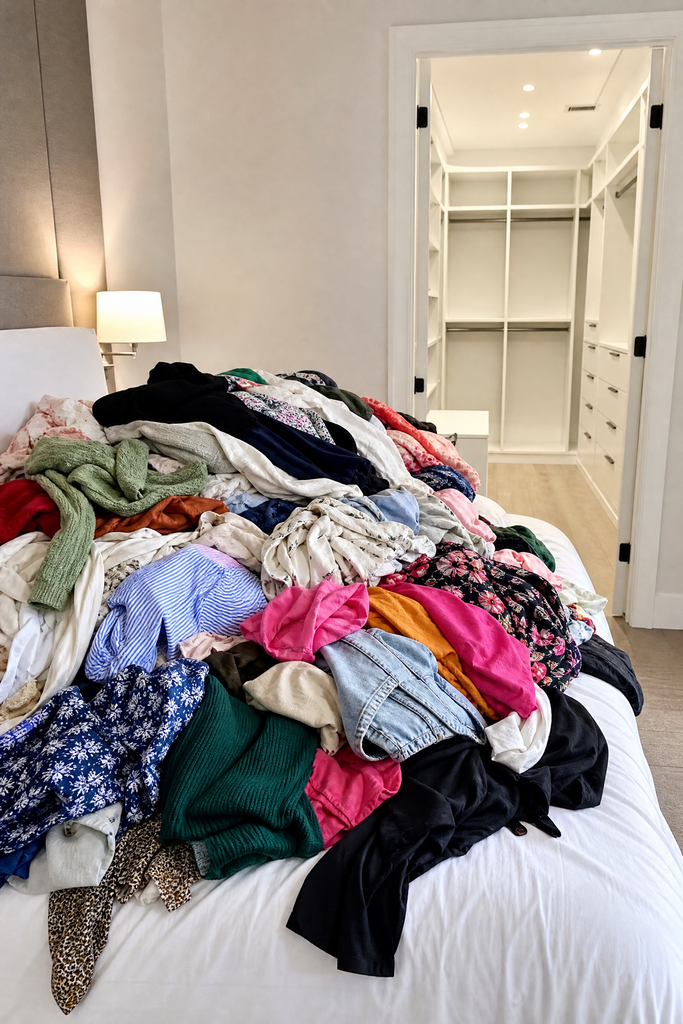
The absolute biggest mistake people make when attempting to organize a closet is trying to sort through their clothing while it is still hanging on the rod. This is completely ineffective because the dense visual clutter prevents you from seeing the items clearly. You must physically remove every single item from the closet and pile it onto your bed. This massive, intimidating pile forces you to confront the sheer volume of your possessions and completely resets the closet as a blank architectural canvas, allowing you to actually visualize new storage possibilities.
Reality Check: Do not attempt this massive evacuation two hours before you need to go to sleep; you must dedicate an entire uninterrupted Saturday morning to this project, or you will end up sleeping on the couch.
The One-Year Rule Implementation
Once your clothing is completely piled on the bed, you must hold every single garment and aggressively ask yourself if you have worn it in the last twelve months. If the answer is no, the item must be immediately removed from your primary wardrobe. We constantly hold onto clothing for a fantasy version of our lives rather than our actual daily reality. By strictly enforcing the one-year rule, you instantly eliminate twenty to thirty percent of the useless volume taking up prime real estate in your closet.
| Garment Category | Keep Criteria | Discard Criteria |
| Formal Wear | Worn in the last 2 years | Does not fit, out of style |
| Daily Casual | Worn in the last 6 months | Stained, stretched, uncomfortable |
| Workout Gear | Worn in the last 3 months | Lost elasticity, torn seams |
Pro Move: If you are genuinely struggling to remember if you wore an item, you did not; immediately place it in the donation pile without a second thought.

The Reverse Hanger Experiment
If you refuse to do a massive one-day purge, you must immediately implement the reverse hanger experiment. Take every single piece of hanging clothing in your closet and turn the hanger completely backward so the hook faces outward. Every time you wear an item and wash it, put it back in the closet with the hanger facing the correct, normal way. After exactly six months, any hanger that is still facing backward holds an item you absolutely do not wear, providing undeniable visual proof that it needs to be donated.
Quick Tip: You must set a strict calendar alarm on your phone for exactly six months from today; otherwise, you will completely forget the experiment and the backward hangers will remain there forever.

Categorical Donation Sorting
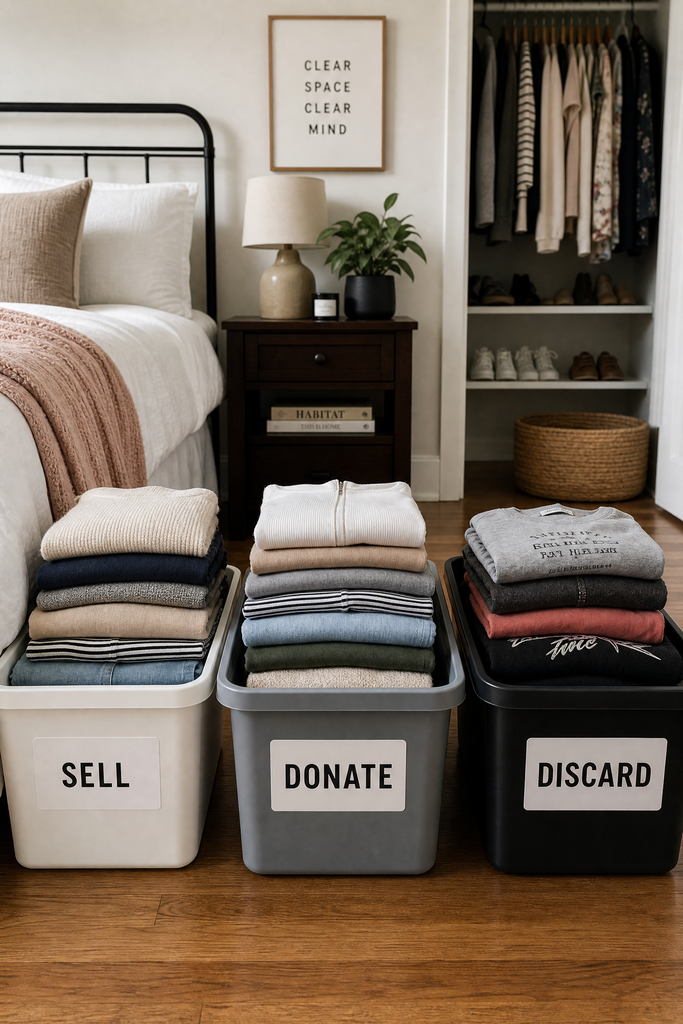
As you aggressively purge your wardrobe, throwing everything into one massive garbage bag creates a secondary organizational nightmare when you try to dispose of it. You must set up three highly distinct, rigid plastic bins labeled: Sell, Donate, and Discard. High-end designer items go into the Sell bin for consignment, gently used standard clothing goes into the Donate bin, and anything stained, torn, or completely ruined goes strictly into the Discard bin for textile recycling. This highly structured system ensures the purged items immediately leave your house efficiently.
Purge Sorting Rules:
- Never put stained or torn clothing in the Donate bin; charities have to pay to throw your garbage away.
- Only place items in the Sell bin if they have a verifiable resale value over thirty dollars.
- Take the Donate and Discard bins out to your car the exact same day you finish the purge.
Designer Advice: Do not leave the donation bags sitting in the trunk of your car for three months; the intense summer heat will completely ruin the textiles and make your car smell terrible.
Seasonal Relocation Strategy
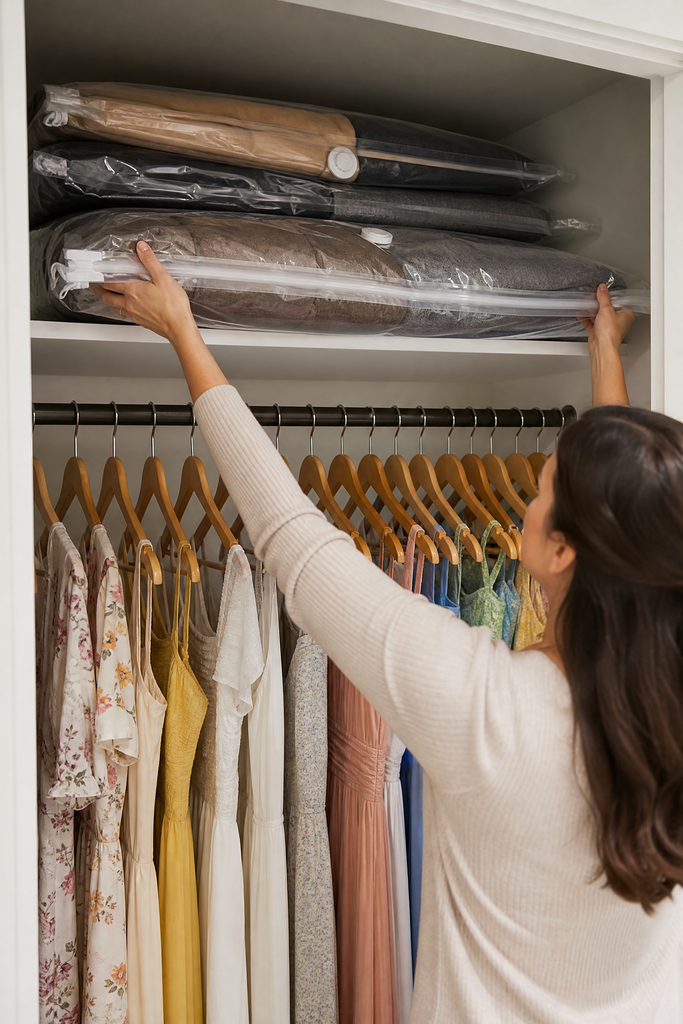
Your primary bedroom closet should only contain clothing that you can actually wear right now, in the current season. Keeping massive, heavy winter wool coats squished next to delicate summer linen dresses completely destroys the visual harmony of the closet and wastes massive amounts of space. You must purchase heavy-duty, airtight vacuum storage bags and physically relocate all out-of-season clothing to a secondary location, such as under the bed or in a hallway linen closet, completely freeing up the prime real estate for daily use.
Heads Up: You absolutely must ensure natural fiber clothing is completely clean and fully dry before sealing it in a vacuum bag; any trapped moisture will instantly breed massive amounts of black mold.
Phase 2: Architectural Optimization
Once the excess volume is completely eliminated, you must aggressively optimize the physical architecture of the closet space. This phase focuses entirely on maximizing vertical volume and exploiting dead zones.
Installing a Secondary Lower Rod
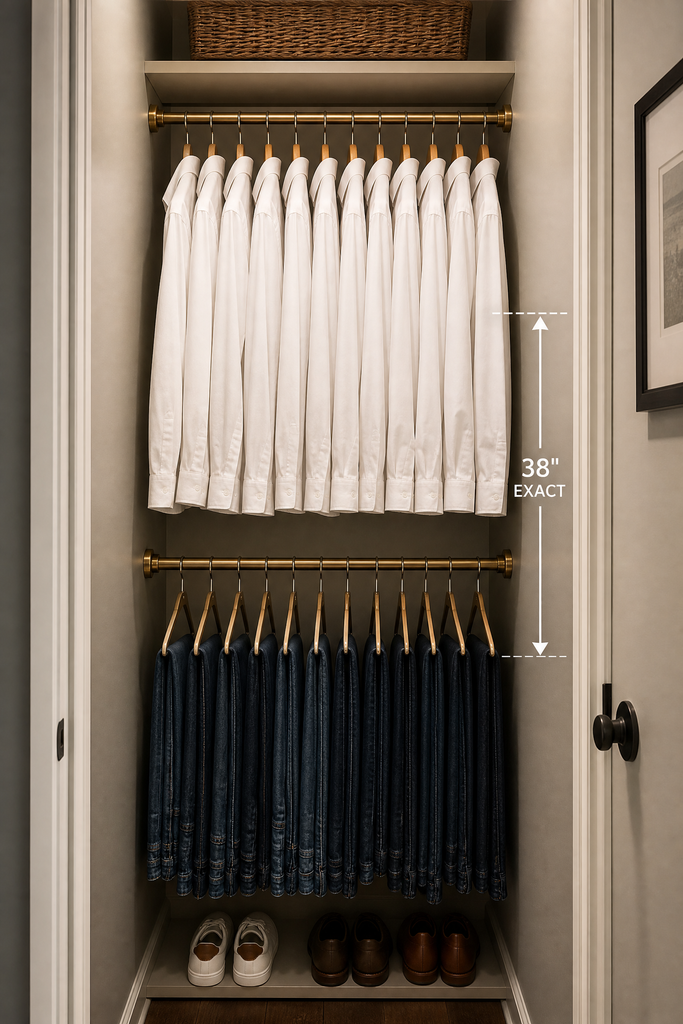
The standard builder-grade closet features a single, incredibly high wooden rod with a massive, completely empty void beneath short-hanging items like shirts and folded pants. You must immediately install a secondary, lower hanging rod exactly thirty-eight inches below the top rod. This brilliant, inexpensive architectural modification instantly doubles the hanging capacity of the entire closet without requiring you to knock down any walls. It is the absolute most effective way to maximize vertical storage space in a small footprint.
Double Rod Installation Guide:
- Measure your longest hanging shirt on the top rod to ensure it will not drape over the new bottom rod.
- Use a highly precise laser level to mark the exact installation points on both side walls.
- Drill heavy-duty wall anchors directly into the drywall if you cannot hit a wooden stud.
- Install the metal brackets and drop the heavy metal rod perfectly into place.
Pro Move: Always dedicate the top rod exclusively to shirts and blouses, and the bottom rod strictly to folded pants and heavy skirts to visually ground the space and prevent top-heavy visual clutter.
Exploiting the High Ceiling Gap
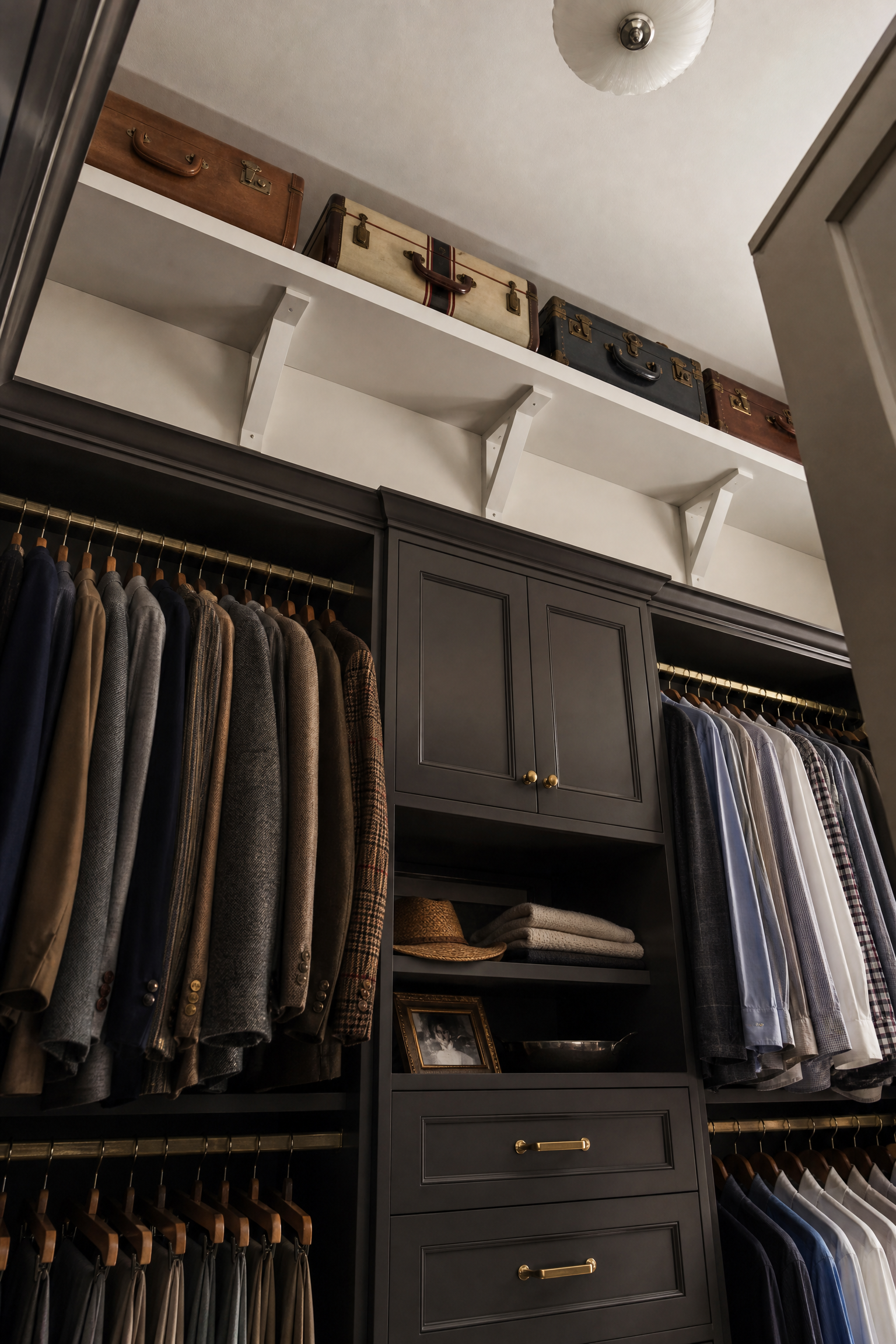
If you have eight or nine-foot ceilings, there is likely a massive, completely useless empty void sitting between your top closet shelf and the ceiling. You must hire a carpenter or utilize heavy-duty metal brackets to install a secondary shelf all the way at the very top of the closet, just twelve inches below the drywall ceiling. This highly inaccessible top shelf becomes the perfect hidden architectural zone for storing bulky, rarely used items like hard-sided travel luggage, seasonal sleeping bags, or massive extra duvets.
Reality Check: Because this shelf is located so incredibly high, you absolutely must purchase a highly stable, foldable metal step stool and keep it permanently inside the closet to retrieve items safely.
The Over-the-Door Canvas Organizer
The massive wooden door of a walk-in or reach-in closet represents twenty square feet of completely ignored, prime vertical storage space. You must install a heavy-duty, over-the-door canvas organizer featuring highly structured, rigid pockets. This completely utilizes the dead space behind the door, creating the perfect shallow storage zone for bulky running shoes, rolled winter scarves, heavy leather belts, and small umbrellas. By moving these chaotic, awkward items off the floor and onto the door, you instantly reclaim massive amounts of horizontal walking space.
| Organizer Material | Durability | Visual Aesthetic |
| Heavy Canvas | Very High | Clean, highly tailored |
| Clear Plastic | Moderate | Chaotic, reveals messy contents |
| Flimsy Nylon | Very Low (Rips easily) | Looks incredibly cheap |
Quick Tip: You must physically screw the bottom of the canvas organizer directly into the wooden door to prevent the heavy unit from violently swinging and slamming against the door frame every time you open it.

Removing the Bi-Fold Doors
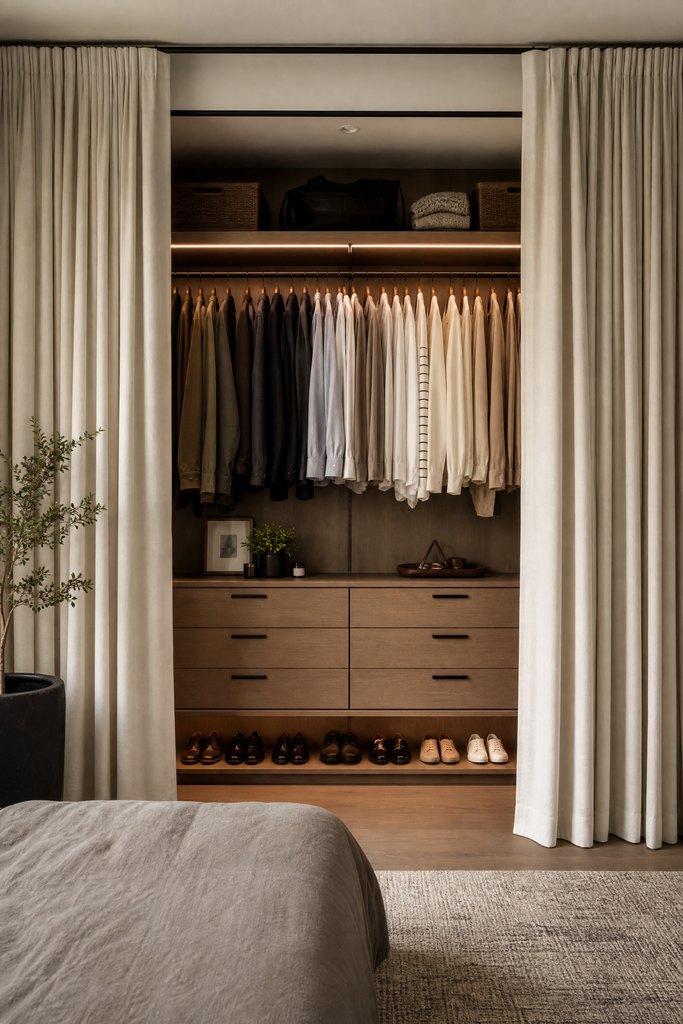
Cheap, hollow-core bi-fold closet doors are notoriously terrible; they constantly fall off their metal tracks, block crucial access to the corners of the closet, and look incredibly dated. The ultimate architectural upgrade for a small bedroom is simply removing the doors entirely and completely finishing the interior of the closet to act as an exposed, high-end open wardrobe. By removing the physical barrier, the bedroom instantly feels significantly larger and more open. This bold strategy forcefully requires you to keep the closet impeccably organized at all times.
Designer Advice: If an open wardrobe feels too exposed, install a heavy-duty tension rod high in the door frame and hang massive, floor-to-ceiling thick linen drapes to provide a soft, luxurious visual barrier.
Wall-Mounted Jewelry Cabinets
Storing expensive jewelry inside bulky countertop boxes wastes massive amounts of prime dresser space and creates a tangled, chaotic mess of expensive necklaces. If you have any blank wall space inside your walk-in closet, you must mount a highly structured, lockable jewelry cabinet directly to the drywall. These incredibly shallow wooden cabinets feature hundreds of tiny hooks and velvet-lined slots, utilizing completely dead vertical wall space to perfectly organize your fragile accessories while keeping them completely hidden and highly secure behind a mirrored door.
Jewelry Cabinet Rules:
- You must mount the heavy wooden cabinet directly into two wooden wall studs, never relying solely on weak drywall anchors.
- Ensure the swinging door has enough physical clearance to open completely without hitting hanging clothes.
- Install a tiny, battery-operated motion-sensor LED light inside the cabinet to illuminate the sparkling jewelry.
Heads Up: Never mount a heavy jewelry cabinet on the exact same wall as a sliding pocket door, as the heavy mounting screws will aggressively pierce the wooden door completely trapped inside the wall.

The Shoe Wall Grid
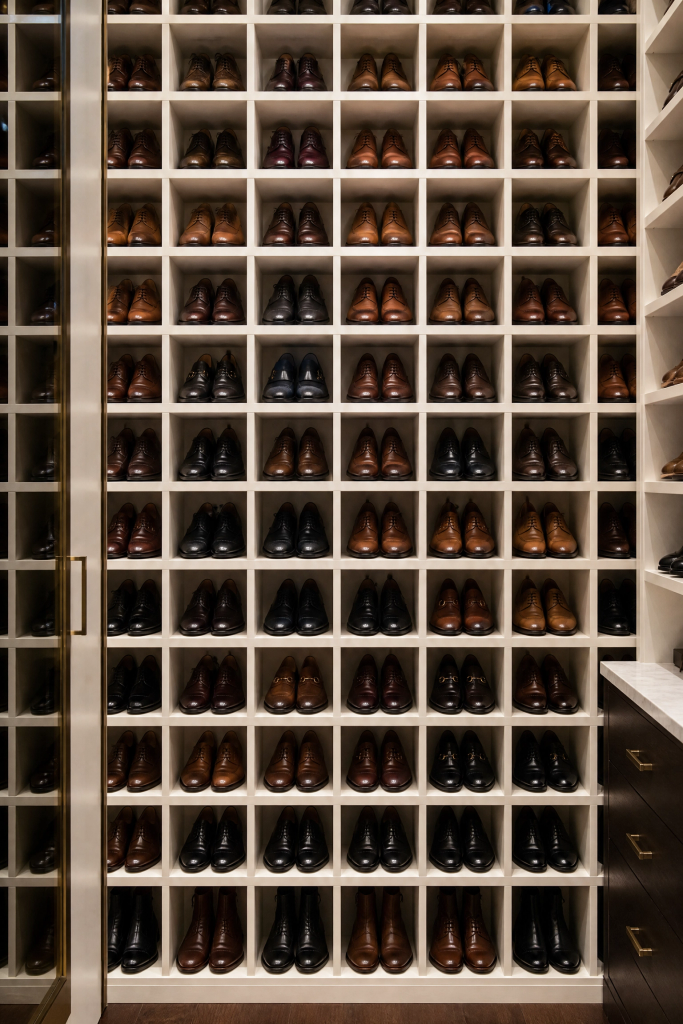
Throwing expensive shoes into a dark, massive pile on the floor completely destroys the leather and makes finding a matching pair a highly stressful daily nightmare. If you have an empty side wall in your closet, you must build a massive, floor-to-ceiling grid of identical, shallow wooden cubbies. By assigning exactly one pair of shoes to each specific cubby, you create a rigorous, high-end retail display that perfectly protects the footwear. This massive architectural grid looks incredibly expensive and instantly turns your shoe collection into a beautiful, highly organized focal point.
Pro Move: You must measure your tallest pair of high heels and your thickest winter boots before building the grid, ensuring the wooden cubbies are physically tall enough to accommodate your specific collection.
Phase 3: Hardware and Storage Upgrades
With the architecture optimized, you must aggressively upgrade the physical hardware and storage containers. Mismatched hangers and cheap plastic bins will instantly destroy the high-end boutique aesthetic.
The Velvet Hanger Unification
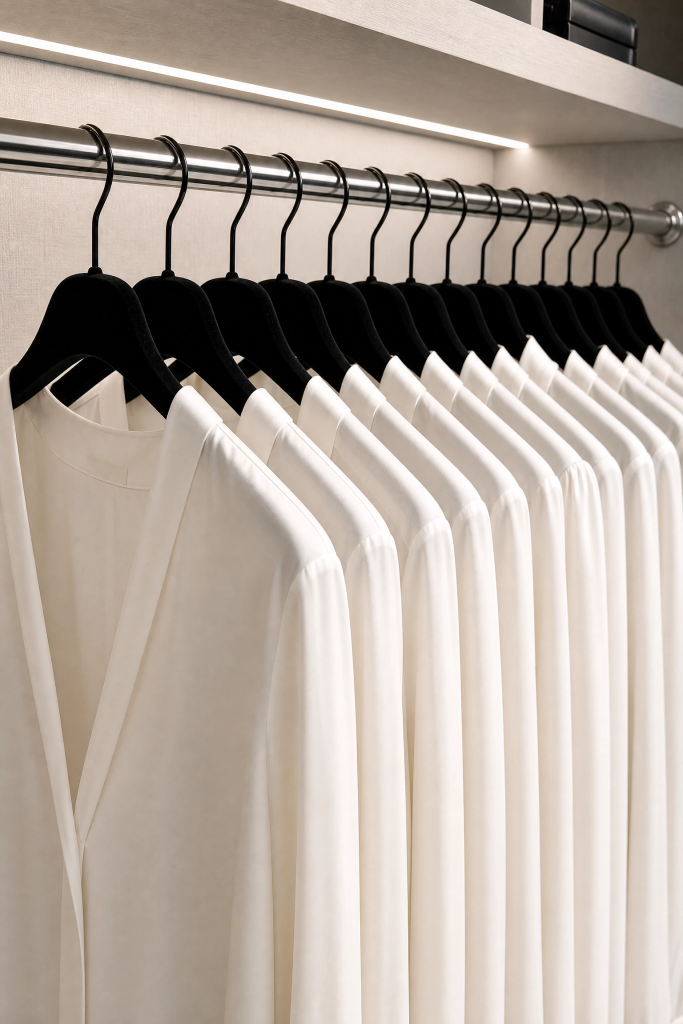
The absolute fastest, most impactful way to instantly upgrade the entire visual aesthetic of your closet is completely throwing away every single mismatched plastic and wire hanger you own. You must replace them entirely with identical, ultra-slim black velvet hangers. The uniform black velvet creates a rigorous, flawless architectural line across the hanging rod, completely eliminating visual chaos. Furthermore, the ultra-slim profile physically saves up to thirty percent more horizontal rod space compared to bulky plastic hangers, while the velvet texture completely prevents wide-neck silk blouses from aggressively slipping off onto the floor.
| Hanger Type | Space Efficiency | Visual Aesthetic | Slip Resistance |
| Ultra-Slim Velvet | Maximum (Saves 30%) | Highly uniform and luxurious | Excellent |
| Thick Wooden | Terrible (Wastes space) | High-end retail look | Poor (clothes slide off) |
| Tubular Plastic | Moderate | Cheap and chaotic | Moderate |
Reality Check: You must never hang heavy, soaking wet clothing on black velvet hangers to dry, as the dark dye will instantly bleed into the wet fabric and completely ruin your expensive white shirts.
Matching Opaque Storage Bins
Storing out-of-season clothing in clear plastic bins completely ruins the clean aesthetic of a closet, as the chaotic mix of colors and patterns is highly visible through the plastic. You must strictly utilize identical, completely opaque storage bins, such as heavy-duty cotton canvas boxes or rigid stark white plastic bins. By hiding the messy contents completely, you create a flawless, highly unified block of color on your top shelves. This rigid unification tricks the eye into seeing a perfectly calm, highly engineered architectural space rather than a chaotic storage room.
Quick Tip: Because the bins are completely opaque, you absolutely must attach highly legible, minimalist brass clip-on labels to the front of every single bin so you know exactly what is hidden inside.

Clear Acrylic Shelf Dividers
Attempting to stack thick, bulky sweaters or heavy denim jeans on a massive, open wooden shelf always ends in disaster; the tall stacks inevitably lean and violently crash into each other, creating a chaotic mess. You must slide thick, perfectly clear acrylic shelf dividers onto the wooden shelves to create strict, rigid physical boundaries between the clothing stacks. The heavy transparent acrylic provides massive lateral support to keep the stacks perfectly vertical without introducing any visual clutter. This simple hardware upgrade ensures your folded clothing looks exactly like a pristine high-end department store display.
Shelf Divider Installation:
- Measure the exact thickness of your wooden shelf to ensure the acrylic clip will fit perfectly.
- Slide the divider onto the shelf, spacing them exactly twelve inches apart.
- Fold all sweaters to exactly the same width so they fit perfectly within the rigid acrylic boundaries.
Designer Advice: Never force a thick acrylic divider onto a shelf that is slightly too thick for the clip; the immense pressure will violently snap the expensive plastic right down the middle.

The Pant Rack Pull-Out
Hanging heavy denim jeans and thick wool trousers on standard hangers takes up massive amounts of vertical space and often causes the pants to crease terribly. If you have custom cabinetry, you must install a heavy-duty, sliding metal pant rack. This highly specialized piece of hardware features multiple smooth metal arms that you simply drape the pants over. The entire mechanism glides smoothly out of the cabinet on heavy ball-bearing tracks, allowing you to instantly view your entire pant collection from a top-down perspective while using half the vertical space of a traditional hanger.
Heads Up: You must install the heavy metal sliding rack incredibly securely into the wooden cabinet walls; the combined weight of twenty pairs of thick denim jeans will instantly rip weak screws out of cheap particleboard.

Structured Handbag Storage
Throwing expensive leather handbags into a massive pile at the bottom of the closet permanently crushes their structure and deeply scratches the soft leather. You must treat your handbags exactly like expensive sculptures by storing them upright on a dedicated shelf. To prevent them from flopping over, you must aggressively stuff the inside of every single empty handbag with acid-free tissue paper or custom purse pillows. This maintains the rigid structural integrity of the leather. Finally, use small clear acrylic dividers between each bag to keep them standing perfectly upright in a highly curated row.
Handbag Care Rules:
- Never hang heavy leather bags by their straps on a hook, as gravity will permanently stretch and ruin the leather handles.
- Keep expensive bags inside their breathable cotton dust covers if you do not use them weekly.
- Never store light-colored leather bags pressed directly against dark denim clothing to prevent irreversible dye transfer.
Pro Move: If you completely lack shelf space, use heavy-duty, wide acrylic hooks specifically designed to cradle the strap rather than piercing it, keeping the bag safely off the dirty floor.

Spring-Loaded Drawer Dividers
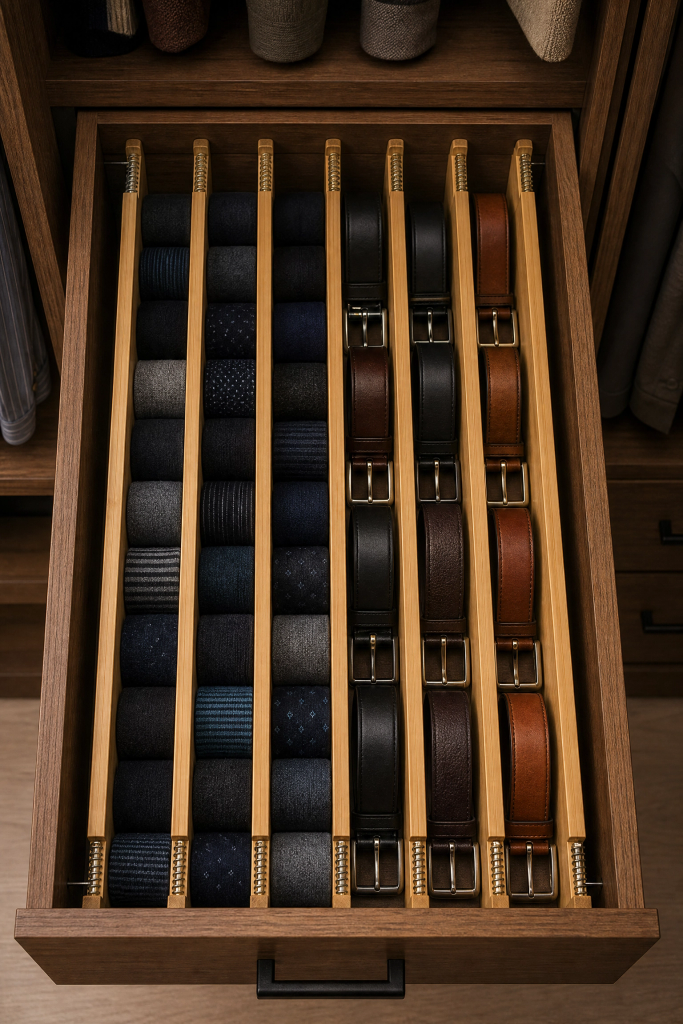
Deep dresser drawers located inside a closet quickly become chaotic, terrifying black holes where socks, underwear, and belts become completely hopelessly tangled. You must install heavy-duty, spring-loaded bamboo drawer dividers inside every single deep drawer. These rigid wooden planks aggressively press against the front and back of the drawer, creating highly specific, permanently separated columns for different categories of clothing. By forcing the chaotic items into strict, architectural rows, you make it incredibly easy to find exactly what you need at six in the morning without destroying the entire drawer.
Reality Check: You must physically measure the exact interior depth of your drawer before ordering dividers; if the spring is compressed too tightly, it will violently blow out the back panel of your dresser drawer.
Motion-Sensor LED Lighting
A dark, heavily shadowed closet makes it completely impossible to differentiate between a navy blue suit and a black suit. Because most closets lack adequate hardwired ceiling lights, you must install massive, ultra-bright LED strip lights underneath every single shelf and hanging rod. To make the system feel incredibly high-end and luxurious, you must connect these lights to a highly sensitive battery-operated motion sensor. The absolute second you step into the closet, the entire space instantly illuminates with brilliant, bright white light, completely transforming the dark cavern into a glowing, pristine boutique.
| Lighting Type | Color Temperature | Best Application |
| Bright Daylight (5000K) | Ultra-crisp and sterile | Perfect color matching (Navy vs Black) |
| Warm White (2700K) | Yellow and cozy | Terrible for closets (distorts fabric colors) |
| Neutral White (4000K) | Clean and balanced | The best overall choice for high-end aesthetics |
Quick Tip: You must rigorously hide the black electrical wires of the LED strips behind the thick wooden lip of the shelves using heavy-duty tape, as dangling wires completely destroy the highly engineered aesthetic.

Phase 4: Styling and Maintenance
The final phase elevates the functional closet into a beautiful personal sanctuary and establishes the strict, rigorous habits required to prevent the system from completely collapsing back into chaos.
Color-Coordinated Sorting
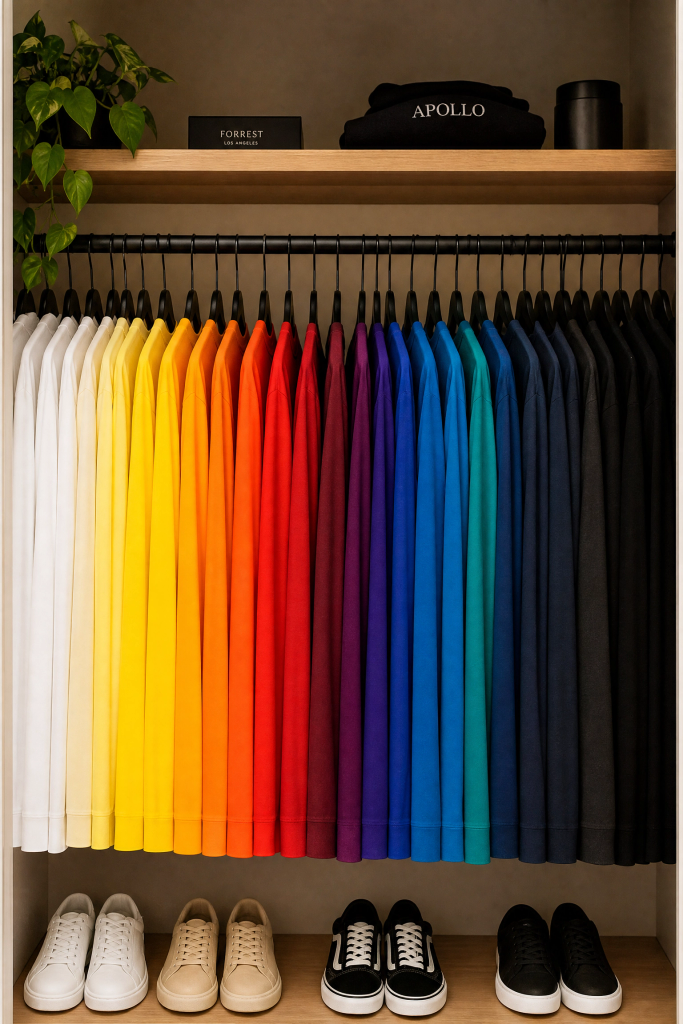
Once all your clothing is hanging on identical velvet hangers, you must implement the absolute gold standard of professional closet organization: strict color coordination. You must organize your hanging garments exactly like the color spectrum, moving from stark white, through the rainbow, ending in dark greys and solid blacks. This highly rigorous visual system is not just incredibly beautiful to look at; it is highly functional. When you need a specific blue shirt, your eye instantly jumps to the exact correct zone, saving massive amounts of time and mental energy during a chaotic morning routine.
The Perfect Sorting Hierarchy:
- First, sort all clothing strictly by category (e.g., all short-sleeve shirts together, all pants together).
- Second, sort within those categories by physical length (shortest hemlines to longest).
- Finally, sort those length categories perfectly by color (White, Cream, Red, Blue, Grey, Black).
Designer Advice: If you have heavily patterned garments featuring multiple colors, you must categorize the item based strictly on the single dominant background color of the fabric to maintain the visual gradient.
The Boutique Display Moment
A highly functional closet can quickly feel like a sterile, utilitarian stockroom if you do not purposefully introduce elements of high-end styling. You must dedicate one small, highly visible shelf at exactly eye level to act as a curated boutique display moment. Instead of cramming it full of folded jeans, display a beautiful, heavy glass perfume bottle sitting on a mirrored tray alongside a framed piece of abstract art or a small faux plant. This highly intentional, completely useless decorative moment provides a massive burst of joy and severely elevates the perceived luxury of the entire space.
Pro Move: You must strictly utilize a heavy, mirrored or brass tray to corral the perfume bottles on the display shelf, treating the items exactly like a curated museum exhibit rather than random clutter.

The Outbox System
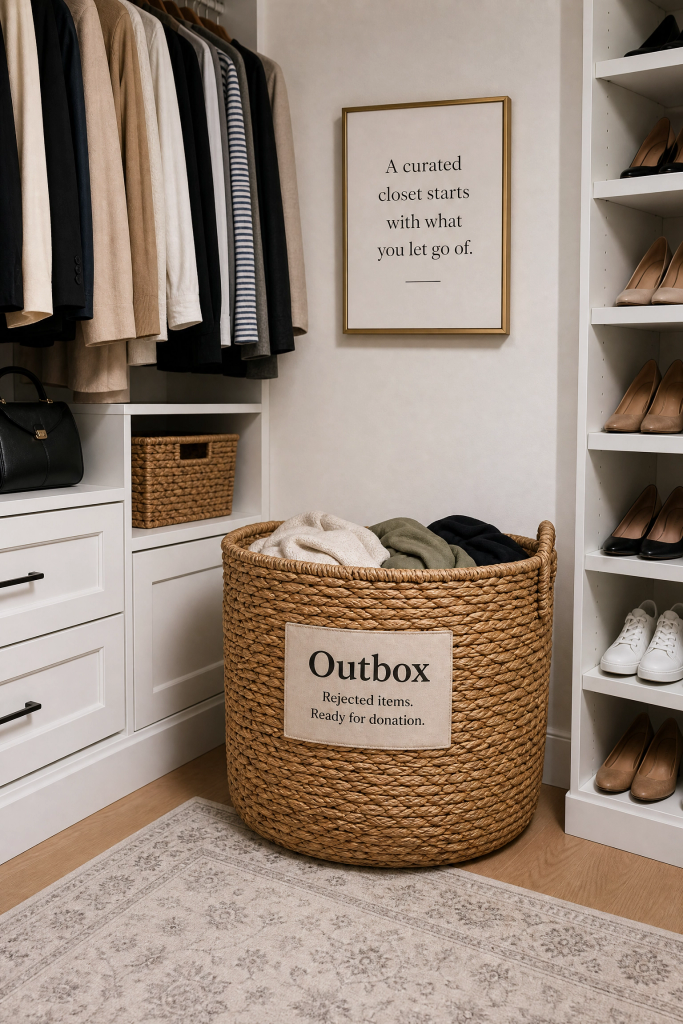
A closet naturally accumulates clutter over time as you try on clothes that no longer fit or discover items that are permanently stained. Instead of throwing these items back into the clean closet or letting them pile up on a chair, you must establish a permanent ‘Outbox’ basket strictly dedicated to donations and repairs. Place a heavy woven basket on the floor in the corner of the closet. The absolute second you put on a shirt and realize you hate how it fits, immediately throw it into the Outbox. This completely prevents bad clothing from reinfecting your clean wardrobe.
Outbox Rules:
- You must empty the Outbox basket the absolute second it becomes completely full.
- Take items needing tailoring to the dry cleaner immediately; do not let them sit in the basket for six months.
- Never ‘rescue’ an item from the Outbox once you have decided to discard it.
Reality Check: If you do not strictly empty the Outbox the moment it fills up, it will violently overflow onto the floor, completely destroying the rigorous organization system you just spent an entire weekend building.
File Folding Technique
Stacking t-shirts directly on top of each other inside a drawer is a fundamentally flawed system; the exact shirt you want is always at the very bottom, and pulling it out violently destroys the entire stack. You must immediately adopt the ‘file folding’ technique, pioneered by professional organizers. You fold the t-shirts into tight, compact rectangles and place them vertically in the drawer, exactly like files in a filing cabinet. This brilliant methodology allows you to instantly see the edge of every single shirt simultaneously, and pulling one out leaves the rest of the highly structured drawer completely undisturbed.
Quick Tip: If your folded t-shirts are completely flopping over and creating a messy pile, you are not folding them tightly enough; they must be folded tightly enough to physically stand up completely on their own.

The Daily Reset Ritual
Even the most perfectly engineered closet system will completely collapse into terrifying chaos if you do not maintain it. You must absolutely commit to the ‘Daily Reset Ritual.’ Every single evening, before you get into bed, you must spend exactly two minutes hanging up any clothes draped over chairs, putting worn shoes back into their exact designated cubby, and closing all the dresser drawers perfectly flush. This incredibly minor, highly disciplined habit prevents the slow, insidious accumulation of clutter and ensures you wake up to a pristine, deeply calming personal boutique every single morning.
| Action | Time Required | Impact on Closet Aesthetic |
| Hanging up one worn jacket | 15 seconds | Prevents chair clutter build-up |
| Putting shoes back in cubby | 10 seconds | Keeps the floor completely clear |
| Closing open drawers | 5 seconds | Maintains clean architectural lines |
Heads Up: If you skip the daily reset for just three days in a row, the massive pile of accumulated clothing on the floor will become so intimidating that you will completely abandon the entire organizational system.

Scented Cedar Blocks
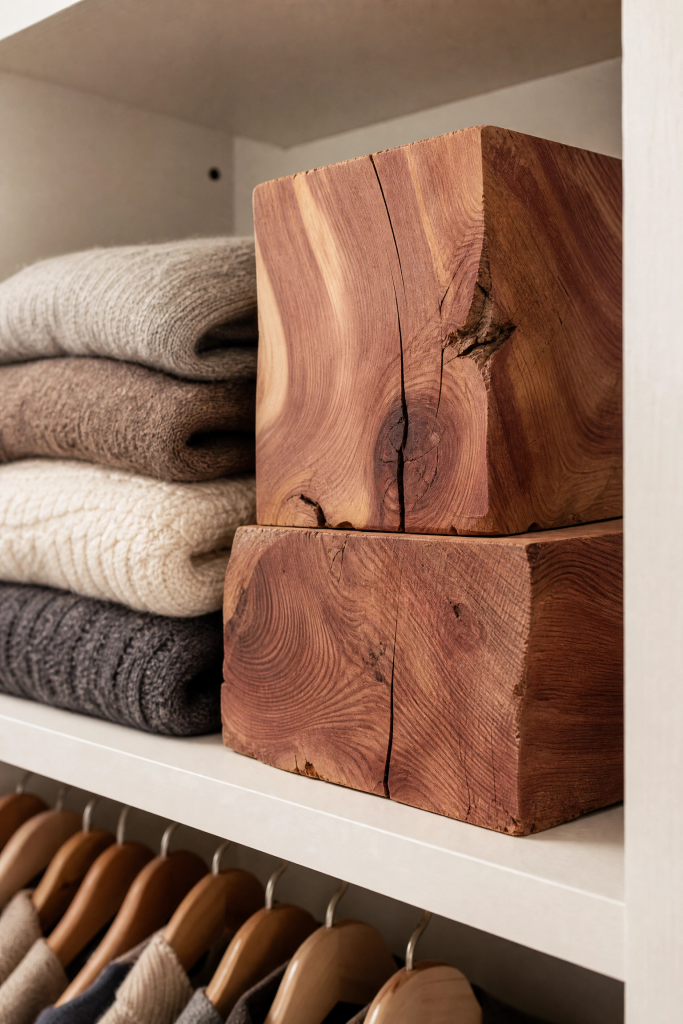
A truly luxurious closet engages all the senses, not just the eyes. A closet that looks beautiful but smells like stale, unwashed laundry is a complete failure. Instead of using cheap, overwhelmingly synthetic chemical air fresheners, you must scatter heavy, solid blocks of natural cedar wood throughout the shelves and drawers. The raw wood introduces massive amounts of deeply sophisticated, earthy scent that perfectly mimics a high-end bespoke tailor shop. More importantly, the powerful natural oils inside the cedar actively repel highly destructive clothing moths, protecting your expensive wool sweaters while making the room smell incredibly expensive.
Designer Advice: Cedar blocks completely lose their scent and moth-repelling power over time; you must aggressively sand the surface of the wooden blocks with rough sandpaper every six months to expose fresh, highly scented wood.
The Matching Hamper Hack
An overflowing, ugly plastic laundry basket sitting right in the middle of your perfectly curated walk-in closet completely destroys the high-end aesthetic. You must hide the dirty laundry by investing in a massive, heavy-duty woven hamper featuring a completely opaque lid. By utilizing a hamper made from the exact same woven material as your upper storage bins, you create a rigorous, highly unified architectural theme throughout the space. The heavy lid completely conceals the chaotic, messy reality of dirty clothes, ensuring the closet remains a highly polished, serene environment at all times.
Hamper Placement Rules:
- Never place a heavy hamper directly in the primary walking path of the closet.
- If possible, tuck the hamper directly underneath a lower hanging rod to completely maximize dead floor space.
- Use a hamper featuring a removable, washable cotton liner to prevent the basket from absorbing horrible odors.
Pro Move: If you have the floor space, buy a massive double-sided hamper that features two distinct compartments, allowing you to pre-sort your darks and lights the absolute second you take them off.

Conclusion
Transforming a chaotic bedroom closet into a highly functional, deeply calming personal boutique is never achieved by simply buying more plastic bins. As this Four-Phase Blueprint clearly demonstrates, successful organization requires ruthless curation, strict architectural optimization, high-quality hardware upgrades, and deeply disciplined daily maintenance. By physically eliminating excess volume, strictly unifying your hangers, maximizing your vertical space, and committing to the daily reset ritual, you completely eliminate the stressful decision fatigue of a messy morning routine. Ultimately, a perfectly organized closet is an incredible investment in your own psychological well-being, providing a highly curated, deeply luxurious space that empowers you to start every single day with absolute clarity and control.
Frequently Asked Questions
What is the very first step to organizing a messy closet?
You absolutely must begin with a ruthless purge. You cannot organize clutter. You must completely empty the closet, pile everything on the bed, and forcefully donate any garment you have not actively worn in the last twelve months before buying a single storage bin.
How can I maximize space in a tiny reach-in closet?
You must aggressively exploit vertical space. Install a secondary hanging rod thirty-eight inches below the main rod to instantly double your hanging capacity. Add an over-the-door canvas organizer to utilize the dead space behind the door, and place a shelf all the way up against the ceiling for bulky, out-of-season items.
Are velvet hangers actually worth the investment?
Yes, they are absolutely mandatory for a high-end aesthetic. Velvet hangers are ultra-slim, physically saving up to thirty percent more rod space than bulky plastic hangers. Furthermore, the completely uniform black color creates a flawless architectural line, completely eliminating visual chaos.
How should I store heavy wool sweaters?
You must never hang heavy wool or cashmere sweaters on hangers, as gravity will permanently stretch the shoulders and completely ruin the garment. You must strictly file-fold them into deep drawers or stack them on shelves using rigid, clear acrylic shelf dividers to prevent the massive stacks from falling over.
How do I keep my closet smelling fresh?
Avoid cheap, synthetic chemical air fresheners. Scatter heavy blocks of natural cedar wood throughout the closet to introduce a highly sophisticated, earthy scent that naturally repels destructive clothing moths. Additionally, ensure you use a laundry hamper featuring a completely opaque, tight-fitting lid to trap dirty laundry odors.
Why does my closet always get messy again after two weeks?
Because you are not executing the Daily Reset Ritual. Even a perfectly engineered closet will completely collapse into terrifying chaos if you do not spend exactly two minutes every single night hanging up worn clothes, putting shoes away, and closing drawers. Organization is a daily habit, not a one-time project.